
Remembering My Miracle Off Ice
Hockeytalk and Duck Calls reach their end

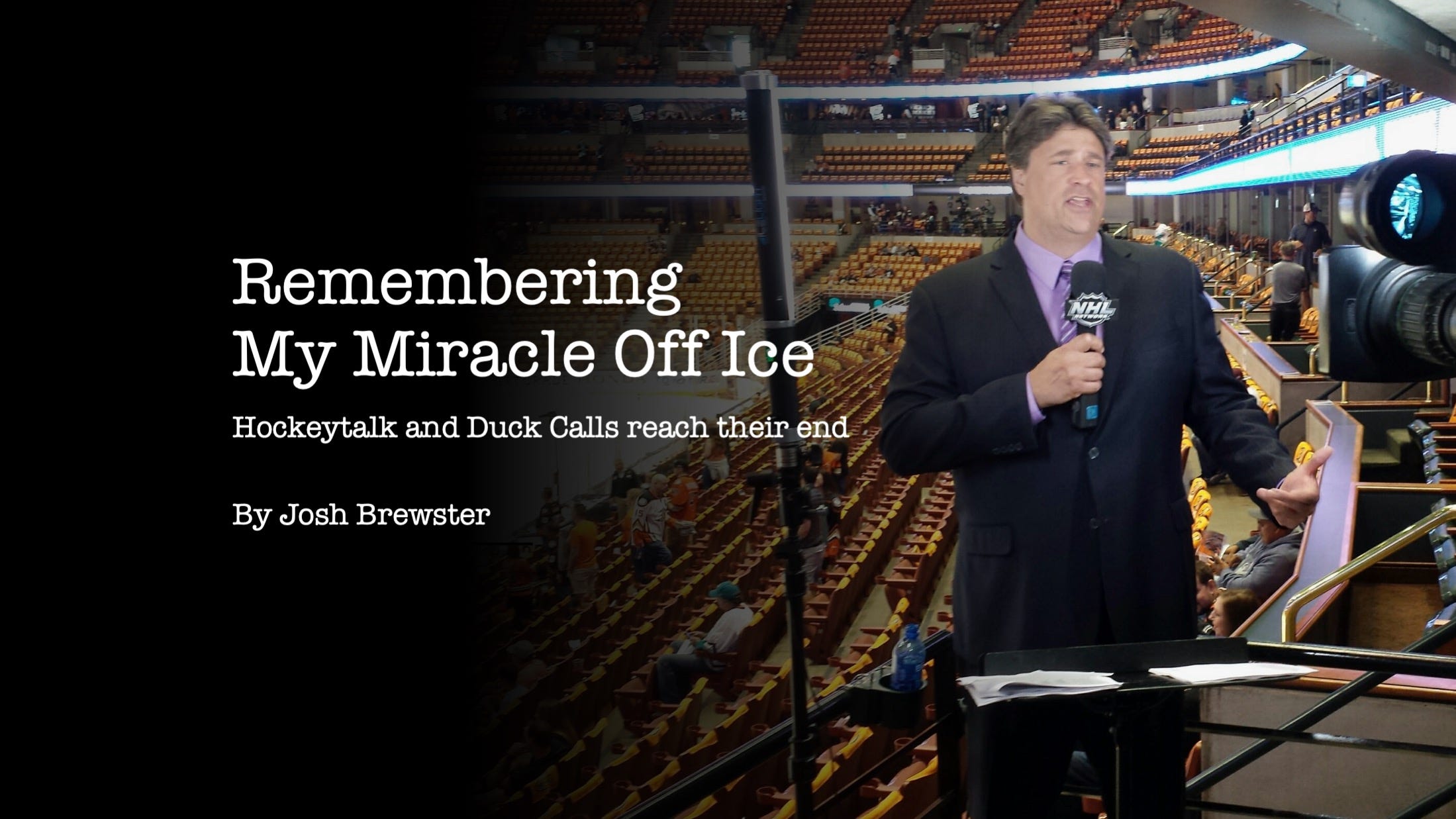
It took a lot out of me and I loved it. I scratched it out of the earth in mid-life with a measure of foresight in a moment of clarity that suggested a level of genius I don’t possess and cannot claim. It was the most satisfying thing I’ve ever accomplished.
Seventeen years as a postgame radio host in the National Hockey League for the Anaheim Ducks came to an end this season. From 2006 to 2023, I could point to my position in the league with pride. It was certainly the greatest stroke of what people call luck that I was ever able to manufacture. This is how I phrase it, since I don’t believe in luck. The “lucky” people in this world are the people who make the best choices and pursue their goals with determination, hard work, and tenacity. That was my route to the NHL.
A show is cancelled. That’s show business. There simply aren’t too many radio or television shows that last 17 years. I had seen careers begin and end during my tenure in the NHL, and I outlasted many. I’m satisfied.
I haven’t been angry about the end of “Duck Calls” as it was known. Not for a minute. I’m filled with gratitude.
TRAFFIC IS A FORCE OF NATURE
I live in the San Fernando Valley, where half of the population of the city of Los Angeles resides. Anaheim is fifty to sixty miles from here, depending on where in the Valley you live. But traffic is a force of nature in Southern California, and like the weather that attracts, the traffic is a repellant and refusing to endure it is a legitimate choice for those who flee the region.
I’d leave for a seven o’clock game no later than 1:30 or 2pm. This was the only way I could make the drive to Anaheim in 90 minutes or less. I learned this the hard way. Early in my career, I’d leave by 3 or 3:30pm for a 7pm game and was fortunate to get to Honda Center by 6:00. I joked that I used prayer, intuition, and even the sense of smell to know which of the half dozen or so routes that I developed across the freeways would work on any given day. Long before GPS, I masterminded schemes involving the 2, 5, 10, 57, 60, 71, 91, 101, 105, 110, 210, 405, 605, 705, and surface streets to shoehorn my way through routes that in many cases and for hours at a time had turned almost literally into parking lots. I remember a day atop a slope of one freeway from which I had a view of the surrounding area and it had become endless snakes of white lights approaching and red lights preceding me; literally miles of people stacked like sardines in a slow-moving chain. It looked like an automotive version of the David Lean film, “A Passage to India.” Oh the humanity.
I worked a day job performing a variety of word processing and contract creation tasks amidst all of this, so I worked all day, and 82 nights each year during hockey season, all night. There were nights where I would arrive at Honda Center exhausted, only to be revived by the sight of the ice below my perch atop the arena. I’d often arrive home at 1 a.m. and wake up again at 5 a.m. to go to work the day gig. This went on for years.
FROM ACTING TO AIRWAVES
I was an actor from the time I was in high school, and a serious one. I attended acting classes year-round during high school at the Studio Arena Theatre in my hometown of Buffalo, New York. I went on to college at SUNY Buffalo, studied acting and set design, appeared in plays in Buffalo, and even started my own comedic troupe, “Schtoinck,” that made a name for itself performing at Hallwalls arts center. I also did voiceovers for commercials at Trackmaster studios (which would turn out to be pivotal in my rise to the NHL).
In 1991, I moved to Chicago and studied improvisation with Del Close. A number of people who would go on to Saturday Night Live and even greater heights were studying and performing there as well. I went on to perform in comedies at Torso Theatre and elsewhere. My last gig in Chicago stamped my ticket to Los Angeles. I landed a good paying gig portraying an anti-smoking superhero for the American Medical Association, “The Extinguisher.” I flew around the country for a year and a half, making appearances across the country with the likes of Ted Kennedy and Al Gore, amongst others.
I saw some of my fellow actors rise to the top of show business, but many hundreds more who would instead spend years slinging headshots and auditioning their lives away. What was the key to success in such a business? I concluded that there were two kinds of people who made it as actors or writers, and it was a concept not unlike that put forth by groups of Alcoholics Anonymous, that is, “attraction, not promotion.” The people I knew who made it in comedy either got themselves into a mainstage position at Second City (Chicago) or Groundlings (LA), did stand-up successfully, or shot their own films and/or produced their own plays. They attracted attention. They had a product. They didn’t spend their careers trying to fit someone else’s cookie-cutter. 99% of all actors are out of work on any given day. Those are the people, I concluded, who spend their lives stuffing headshots into mailboxes (done electronically today). The people I knew who had achieved big careers had people lining up to see them at venues such as the ones I mentioned above or found a way to get their work in theatres. I won’t mention them here by name, but they impressed me, and I admired their choices.
I moved from Chicago to Los Angeles in February 1998, and within 18 months I quickly soured on pursuing acting any further. At 34 years of age, in September of 2000, I made a difficult career choice. My career would change. I always wanted to be on radio. But how?
Around 1987, when I was doing voiceovers during college in Buffalo, I met Robby Takac, bassist and co-founder of the Goo Goo Dolls, who was working as an engineer at TrackMaster studio. His band was catching a tread. I had seen them many times at small local venues like the Continental, where they played often, for a three dollar cover charge; they were exciting, chucking themselves around the small stage, Robby walking around the club and stage barefoot, paying no mind to the booze-soaked and sometimes glass-strewn floor. We became friendly, and I remember one time he was walking by my apartment on Bryant Street, came up and we hung out listening to the earliest Bad Brains and Red Hot Chili Peppers records. Over the years, I’d see him when the Goos came through Chicago during the 1990s, en route to becoming one of the most successful rock bands of their generation.
In early 2000, Robby called me. He had moved to LA, living just a short drive up the hill near Universal City from where I lived in Burbank. While I continued to pursue voiceover work in Los Angeles, Robby generously gave me a very expensive Neumann 87A microphone (I still have it). He taught me how to record and edit audio on a personal computer.
I began attending a radio school in Hollywood that offered an opportunity to do short shows which were broadcast on a local frequency in short range, but most significantly, the shows were streamed on the web. This was in the fall of 2000, the very early days of streaming. The school, the American Radio Network (ARN) offered me an opportunity to get press credentials. Since I was interested in hockey having grown up in Buffalo, I began to apply for credentials to clubs in the now-defunct West Coast Hockey League, which had teams in Bakersfield (Condors), Long Beach (Ice Dogs), and San Diego (Gulls). This was a league where no one was going to make the NHL. It was for guys on the way down and out, but they played with passion and the fans loved the action. Fortunately, the NHL Kings and then-Mighty Ducks (later the Ducks) approved my press credentials and I covered games at the lowest and highest levels of professional play. A shot of confidence came when a publication I’d read my entire life, The Hockey News, hired me to contribute short articles about the WCHL.
I couldn’t believe that I was part of the press corps. I was over the moon to be interviewing pro hockey players, and meeting players who had gone on to work for teams after their careers as well.
I crafted a radio show while at ARN that I called “The Western Hockey Radio Show,” and I’d play the clips I collected at WCHL and NHL games along with my commentary. I was also able to take calls. I had little idea regarding decorum and had to learn some simple rules of how to conduct myself amidst players. One funny moment was when I would ask players to say “hi, you’re listening to the Western Hockey Radio Show,” and the LA Kings specifically asked me not to ask the players to do so. Oops. Sorry. Another funny moment was when I got a very drunk Cuba Gooding, Jr. to do an interview at an Ice Dogs game: “I just pay the bills with that acting crap!”
By 2002, I had become acquainted with Dennis Bernstein, who would go on to become a dear friend. We were both writing for a site called IntheCrease.com, created as a labor of love by a guy named Joe Levandovsky. It was one of the early hockey sites, and we published stories about the NHL, with me adding some stories about the West Coast League.
Dennis had begun a hockey radio show on Mike Horn’s Cable Radio Network (CRN). Bernstein rented time at CRN and he would invite me often to appear on what he called “Hockey Night in America,” with his friend, the late John Artinian. The three of us did some shows there for a few months. CRN was decades ahead of its time, broadcasting radio via cable television channels. Now, it is available on a wide array of traditional broadcast outlets and the internet. Horn was a pioneer and to this day is a radio giant. His daughter, Jennifer, hosts a morning show on broadcast radio in LA, and the whole idea of radio through alternative means that predated the internet is a legitimate stroke of real genius. I remain in awe of what Horn has accomplished.
Dennis and I both emerged out of SoCal around the same time, and both of us were too old to go work our way up the broadcasting ladder in some far-flung locale in our 20’s and 30’s like most sportscasters do. Dennis has gone on to comment on hockey nationally, most notably on SiriusXM on a daily basis and he has a special place in my career. We each found a niche in the hockey media world in mid-life and leveraged it in the NHL from the league’s sunniest climes. Not an easy task.
In 2003, I rented some time at CRN during the playoffs and the Mighty Ducks’ run to the Stanley Cup Finals, a series they’d lose in a heartbreaking seven games to the New Jersey Devils. Paul Kariya would score one of the most memorable Cup final goals after being laid out in Game 6 by a Scott Stevens hit that concussed him, only to return minutes later (to this day he says he doesn’t remember scoring the goal). That series also featured goaltender Jean-Sebastian Giguere capturing the Conn Smythe Trophy as playoff MVP. Mike Eisner, the head of Disney and founder of the team, was in attendance that playoff season, which was rare. It solidified the club’s reputation ten years after its founding. It was also at this time that I met the radio voice of the team, Steve Carroll, who introduced me to a person who would change my life, Aaron Teats, then-director of broadcasting, now president of the team.
I WAS PODCASTING BEFORE PODCASTING WAS PODCASTING
I took the Neumann microphone and asked myself what I could do with it other than create voiceover demos.
This was my moment of clarity and foresight.
I realized that with the internet offering an opportunity to listen to audio and radio by simply clicking a link, I could produce programs by using the Neumann microphone and record guests via a speaker phone. The Neumann was very powerful (you see hosts such as Howard Stern use them). If I set the mic to an omnidirectional setting, and placed it between myself and the speaker phone, I could level the sounds on my computer to make them even, then create an mp3 and post it to the web. I would no longer need to spend money on renting radio station time. I could produce as much programming as I wanted.
Due to the state-of-the-art microphone, it sounded as good as anything coming out of my radio.
Around this time, users’ home internet evolved from telephone wire to Ethernet cords. When this happened, I knew that sound would be easy to stream. The Western Hockey Radio Show was often tough for people to listen to because the bandwidth over telephone lines was not nearly as robust as what they’d get from Ethernet cords. I was convinced that I could reach people with the new technology.
I built a website called Hockeytalk.biz to post my articles and internet show, “Hockeytalk Audio Features” (HTAF). I began inviting guests. I’d tell them it was a new way of doing things and I referred to it as “web radio.” Some would hesitate, but since it was the same type of involvement as a “regular” radio show—simply take a phone call—they were easy to book as guests.
I booked the likes of Stan Fischler, Bob Miller, Mike Barnett, E.J. Hradek, Ed Olczyk, Ray Ferraro, Pete Weber, also authors of recent books about hockey including George and Darril Fosty, who wrote the groundbreaking “Black Ice,” about the Colored Hockey League of the Maritimes in the late 1800’s/early 1900’s, which was history that few had uncovered. Susan Foster was another. She, with her boyfriend, the late Carl Brewer--an NHL legend--and others, successfully tore down crooked players union boss Alan Eagleson. Hockeytalk audio began catching on, was enormously satisfying, and according to my statistics, thousands of people were listening to HTAF at Hockeytalk.biz. I began receiving calls from radio stations to appear as a guest.
I produced HTAF starting in 2003. Mind you, this was all for free. There were even times when I put my last ten dollars into my gas tank just to make the drive to Bakersfield. This level of dedication was drilled into me during my acting days, and it served me well in developing my career in hockey media. During the 2004-05 season, the NHL missed a season due to a labor stoppage, but I continued to produce HTAF.
It’s interesting to see how web radio ultimately evolved into podcasting technology years after HTAF. Somehow I was podcasting before podcasting was podcasting.
I was at my wits’ end though by the summer of 2006. I had been cold calling advertisers on and off since 2003, when I attempted to sell a hockey radio show featuring myself and former NHL GM and broadcast analyst Neil Smith, who had assembled the New York Rangers team that won the 1994 Stanley Cup. I had spoken to people far and wide about that project and others, but I couldn’t get anyone to bite.
I’d done it all for free for years while keeping a full-time job. Aside from some ad revenue that came in from the OLN Network (later “Versus” and NBC Sports Network) and a few dollars for some Hockey News and Hockey Digest writing. Things were looking bleak, and I considered ditching the whole enterprise.
FROM MIGHTY TO DUCKS
In early 2005, Disney sold its team to Henry and Susan Samueli. Henry had amassed a fortune as an engineering whiz and businessman who had his name on dozens of patents. One of his biggest successes was Broadcom, and he’s recognized as an early internet pioneer and developer of technology that ended up on smartphones, amidst god-knows-how-many other things he’s done. His parents had survived the Holocaust, and he spent his early life in Buffalo before the family moved to Los Angeles, where his father owned a liquor store. He told me that he grew up in Northridge, where I currently live, in the Valley. He and his wife Susan had adopted children, which is near to my heart, since I am adopted.
One year after purchasing the team, and hiring Brian Burke as GM, the Mighty Ducks shortened their name to “Ducks.” They held a fan event at Honda Center late in the summer of 2006 to unveil their new jerseys and the press was invited. “I want them to look tough,” said Susan at the event that featured their new black and white jerseys trimmed with gold and orange. Corey Perry and Todd Marchant (another Buffalonian—we both went to Williamsville East High School, though I’m older than Todd) modeled the new uniforms. I took photos for Hockeytalk.biz.
The Fall 2006 event included a luncheon. I saw Aaron Teats, who was director of broadcasting back then. I had tried to get his attention over the three previous years, calling him once or twice a year, saying hello if he happened across my path at Honda Center. I knew that if I ever had a chance to work in the NHL, this would be it.
Like a kid counting to three and holding his breath before jumping into a lake from a pier, I manned up and shook Aaron’s hand.
“Aaron, you’ve seen what I’m doing with these web radio shows?”
He nodded, said yes.
“Well, if there’s anything that I can do for you, full-time, part-time, or even just once in a while, let me know.”
“Okay,” said Aaron.
OFF THE SET AND INTO THE NHL
I considered getting involved in acting again, taking one more shot at that, resurrecting my longtime dream. I was directed to an old friend, Greg Lindsay, who moved from Niagara Falls to Chicago at the same time as me back in 1991. We had done a local comedy television show together in Buffalo. He was shooting a movie, a comedy called “Joe Dick,” that he starred in and directed. It’s on Amazon and elsewhere now. I played a big tough gangster in a scene that took one day to shoot. It’s the first and so far only film I’ve ever done.
I called in sick to my day job to shoot my scene that day. When I was done, there was a voicemail waiting for me. Four weeks after holding my breath and letting Aaron know that I was interested in working for the Ducks, his voicemail explained that he wanted me to be the Ducks’ postgame radio host.
Mid-life miracle off-ice: I became the first broadcaster to make it from the web directly to the National Hockey League.
DUCK CALLS
For the first eight seasons, Duck Calls with Josh Brewster aired after road games. During its last nine seasons, it aired after all home and away games.
During the show’s first broadcast in October 2006, I shook like a leaf. I could not believe what had happened.
I saw this as an opportunity to expand on the postgame format by featuring guests from around the world of hockey. I think the Ducks initially had expected a simple call-in show, but I wanted more, and Teats gave me free reign to run the show as I wished. I picked the intro/outro music and booked all of the guests during its 17-year run.
It was great to work for a person who had the courage of his convictions. Aaron did not micromanage my show, only gave me show notes when it was necessary, which was only a few times each season, and his feedback was always dead-on.
During that first season of the show, the Anaheim Ducks won the Stanley Cup. Being on the ice for that was amazing. I was still the new guy, and didn’t feel like I totally fit in, but I was out there, and Dustin Penner let me lift the Cup with him.
Hockeytalk Audio Features became a thing of the past once I had done a year or two of Duck Calls. I had developed a network of contacts around the world of hockey and I honed my skills in talent booking. The tough part of booking talent for the show was 1) it was based in the Pacific Time Zone; and 2) I refused to pre-record anyone not named Wayne Gretzky or Gary Bettman. The show was live and I insisted that guests appear at the time the show aired in case any callers wanted to speak with them.
Duck Calls aired on KLAA AM830 until the Spring of 2022. The station is owned by the Anaheim Angels. The first year, the studios were in the Sherman Oaks Galleria, the mall made famous in Frank Zappa’s early-80s hit, “Valley Girl.” It was close to my home. If only the station had stayed there and not moved to Angels Stadium! It would have saved me a million hours in traffic, a bunch of grey hairs, and tens of thousands in gasoline. The next 15 years the show was done from Angels Stadium. Paul Sakrison, Howard Drescher, Alejandro Valenzuela, Derrick Taylor, Chris Norman, Aaron Fry and Armando Diaz were very good at keeping the show running technically and I applaud them.
For many years, I used a remote unit to broadcast all the road games from my home studio, which was in my garage, then later, in a shed. In such convenient environs not normally equipped for broadcast I did the best I could. I often prayed that chirping crickets wouldn’t show up. At one point, a wonderful neighbor agreed to put her seven barking dogs in the house during my show. I lined the walls with audio muting sheets, 11 of them at $75 a pop.
The last year of Duck Calls, the 17th, was on DucksStream, which is where you’ll find Ducks games to this day, after the club decided to launch its own 24-hour-per-day streaming service. I had no problem with moving to streaming, but the club didn’t promote the call-in aspect of Duck Calls as much as it should have. Halfway through the 2022-23 season, there were people at Honda Center asking me where they could hear my show, which was not a good sign.
FRIENDS AND REGULARS
I’m most grateful to guests who became regulars who were always accommodating despite late hours, including Mike Barnett, Pete Weber, E.J. Hradek, Linda Cohn, Jimmy Devellano, Jeremy Roenick and Keith Jones. The list of well-known guests is too numerous to mention.
Mike helped me book Gretzky in 2017. Wayne was the first hockey player I ever interviewed when I was 15 years old, for my high school newspaper. He was 21 at the time. When he appeared on my show, he was 56.
Gary Bettman was a gem, a very accommodating guest. I don’t like that the fans are so brutal to him. It’s undeserved. Bettman saved the NHL from itself and as a result it’s more successful than it’s ever been. The product on the ice is as good as ever. (By the way, to my hometown Buffalo Sabres fans: The reason you still have a club to cheer for is Bettman, who refused to sell the club when the Rigas family ruined the franchise, so don’t boo when you see Gary).
I learned something over the years: people on the way up can be a pain on occasion, but the true superstars are the greatest gentlemen. The people who had really made it in this world were the most patient, generous, and understanding. Alan Thicke was a great example, as was Bernie Parent.
I assembled a group of local writers, broadcasters and podcasters to whom I am indebted. They were key since the show was in the Pacific Time Zone. I know they enjoyed appearing on the show, but they contributed more than they know: Brian Kennedy, who featured me in his book, “Living the Hockey Dream”, Doug Stolhand, host of the Puck Podcast, reporters Leon Rafner and Joel Bergman, radio guy Charles Smith, TV guy Jon Rosen, John “The Mayor” Hoven, and Dennis Bernstein.
At SiriusXM, I received support from Jim “Boomer” Gordon basically any time I needed a guest. Mick Kern, Steve Kouleas, Jake Hahn, Jamie Shalley, Joe Thistel, Peter Berce, Tyler Madarasz, Scott Laughlin and Nick Alberga were all solid and I thank them for not only doing the show, but for having me as guest on theirs. Hockey radio is scarce in the United States, and though it emanates from Canada, it’s the gold standard for American hockey fans.
Tiffany Spiritosanto worked for Ducks broadcasting during the first 15 years of the show’s run. Like Aaron, she had faith in the show and was very loyal. They stuck by me, and I’m very grateful. And may you find a boss who believes in you the way I did during my years in the NHL with Aaron Teats.
Ducks PR guy Alex Gilchrist opened the door to the NHL for me, he always made things easy, got me access to players and others. I would never have met Aaron without Alex’s help. I would feel remiss if I didn’t point out that that two guys from our cross-town rival Kings, Mike Altieri and Jeff Moeller gave me access to their arena and team early on, so I’m indebted to them for giving me an early boost.
The prominent hockey people who I got to know over those years included some notables who I really liked. Brian Burke was one. “Never confuse education with intelligence,” he has been known to say. Couldn’t be more true. Burkie is well-educated, but he’s down to earth.
ONE DOOR CLOSES
I think I need a break. It was all a lot to do, especially with raising two boys, now 16 and 18, and holding a full-time job (yes, the Ducks paid me well, but this is LA, and it costs a fortune to live, so off to work I go).
From my early internet days to all those years with the Ducks, I was married, divorced and remarried to the same woman, Catherine Pelonero.
The bottom line is that when I was starting this journey, this career change, this personal miracle off ice, the person who didn’t raise an eyebrow, who believed fully in the Western Hockey Radio Show, Hockeytalk Audio Features, and Duck Calls was Catherine. She didn’t think I was crazy for aspiring to do a hockey show in Southern California. She thought it made all the sense in the world. This was before the Ducks won their Cup, before the Kings won their two, before interest in hockey skyrocketed to where it is today in Southern California. She told me I wasn’t crazy. In this life, I hope you find a spouse who thinks your crazy ideas make all the sense in the world.
Copyright 2023 Josh Brewster | All rights reserved